

In a landmark study published in Nature, researchers have, for the first time, systematically mapped the microbiome of an entire nation: the Microflora Danica project in Denmark. Led by the University of Aalborg, the project analyzed over 10,000 environmental samples across Denmark, creating an unprecedented atlas of microbial life.
CoE Microplanet Director of Research Michael Wagner (Uni Wien), together with CeMESS colleagues Daan Speth and Andrew Giguere, focused on analyzing nitrifiers, a group of microorganisms central to the global nitrogen cycle.
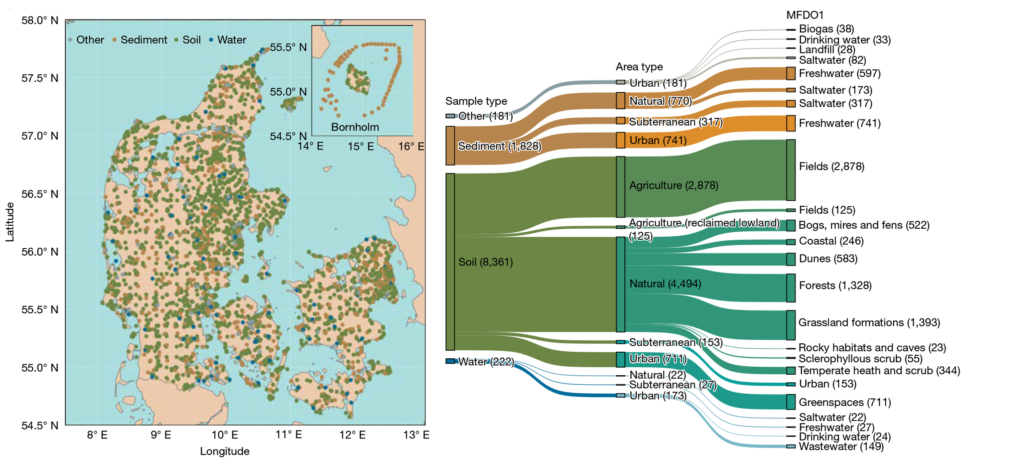
Left: The MFD samples cover the land of Denmark and its surrounding waters. The map depicts the locations of the samples used for metagenomics, and the colours represent the three different sample types. The top right cutouts show the island of Bornholm, which is east of Copenhagen and south of Sweden. Right: Sample counts in the first three levels of the habitat ontology. The MFD habitat ontology accounts for a variable number of samples per category/branch. Each habitat category is followed by the number of samples for that category in parentheses.
They show that both agricultural and natural soils are dominated by nitrifiers that have never been cultivated in a laboratory setting. Also, the degree of habitat disturbance, particularly intensive farming, is clearly reflected in microbial profiles. While locally diverse, disturbed habitats are significantly homogenized on a national scale, whereas natural habitats preserve overall diversity.
These results serve as a model case for other countries, such as Austria, where agriculture, nutrient inputs, and water protection shape environmental policy. A national microbiome atlas opens new avenues for combining agriculture and nature conservation on a data-driven basis.